
The COVID-19 pandemic demonstrated the vulnerability of European industry and showed with greater emphasis the digitalisation of it as a strategic imperative. However, the challenge for European SMEs is not simply to be digital but to transform themselves into “Bionic firms”: companies that are capable of effectively combine technological, transversal and leadership skills achieving in turn more productive operations and greater innovation.
GIST has the aim to develop innovative training material for SMEs to provide them with the basic competencies needed to reach this “Bionic Status”.
The project especially focuses on the companies of the furniture sector, a field in with the 4th industrial revolution had not entered massively due to under-invests in the R&D&I, a typical SMEs disability. The organisations involved are indeed preoccupied with the shortage of skilled personnel and the ageing workforce. Hence, a life-long learning pathway to upskilling and reskilling the SMEs’ workers seems to be a priority.
GIST produces the following results:
IO1. GIST training path definition which encompasses a key study based on current knowledge, skills and qualifications regarding digital transformation. It will result in a Joint Curriculum that defines the needed learning outcomes and covers previously identified skill gaps.
IO2. GIST Training content development addresses the following topics organized in microlearning modules: I) Introduction to digital transformation; II) Industry 4.0 Key Enabling Technologies for Bionic transformation of SMEs; III) Transversal skills for Bionic transformation of SMEs and IV) Leadership skills for Bionic transformation of SMEs.
This is the main result of the project developed to be used by traditional companies in the furniture sector that think about moving forward to the digital transformation. The training course and the general methodology will be available for other centres and professional organisations and could be adapted for other manufacturing industries.
IO3. GIST Collaborative platform and verification action. In this intellectual output GIST will develop a collaborative platform where all the content developed in IO2 will be integrated based on micro-learning methodology designed to meet a specific learning outcome. Then, with a Verification Action the target users will handle, check and assess the final training content ensuring that it has a real utility and interest for the main stakeholders.
Main target group of the project are SMEs from furniture and related sectors.
We conducted a comprehensive study to assess the current skills, knowledge, and qualifications relevant to digitalization. Based on the findings, we identified the necessary learning outcomes essential for the development of the training course. Subsequently, we defined the methodology and established the learning paths, resulting in the creation of the Joint Curriculum.
Following this, we meticulously developed structured training content that effectively addressed the previously identified needs. We ensured that all materials were released under open Creative Commons licensing, promoting accessibility and sharing.
Moreover, we successfully created a user-friendly e-learning platform that seamlessly integrated content in all consortium languages. Rigorous testing and validation processes were conducted to ensure the quality and effectiveness of both the platform and the content. This platform serves as a valuable resource for learners and stakeholders.
As tangible outcomes, we have generated various reports available on the project website, which comprehensively describe and reflect a significant portion of the work accomplished. Additionally, we have created a multilingual platform featuring all the integrated training materials in seven languages: English, German, French, Polish, Spanish, Croatian, and Slovenian. Furthermore, the project’s website features a dedicated news section that provides regular updates on transnational meetings, learning,
teaching, and training activities, multiplier events, and more. These updates showcase the project’s progress, achievements, and milestones, keeping stakeholders informed and engaged.
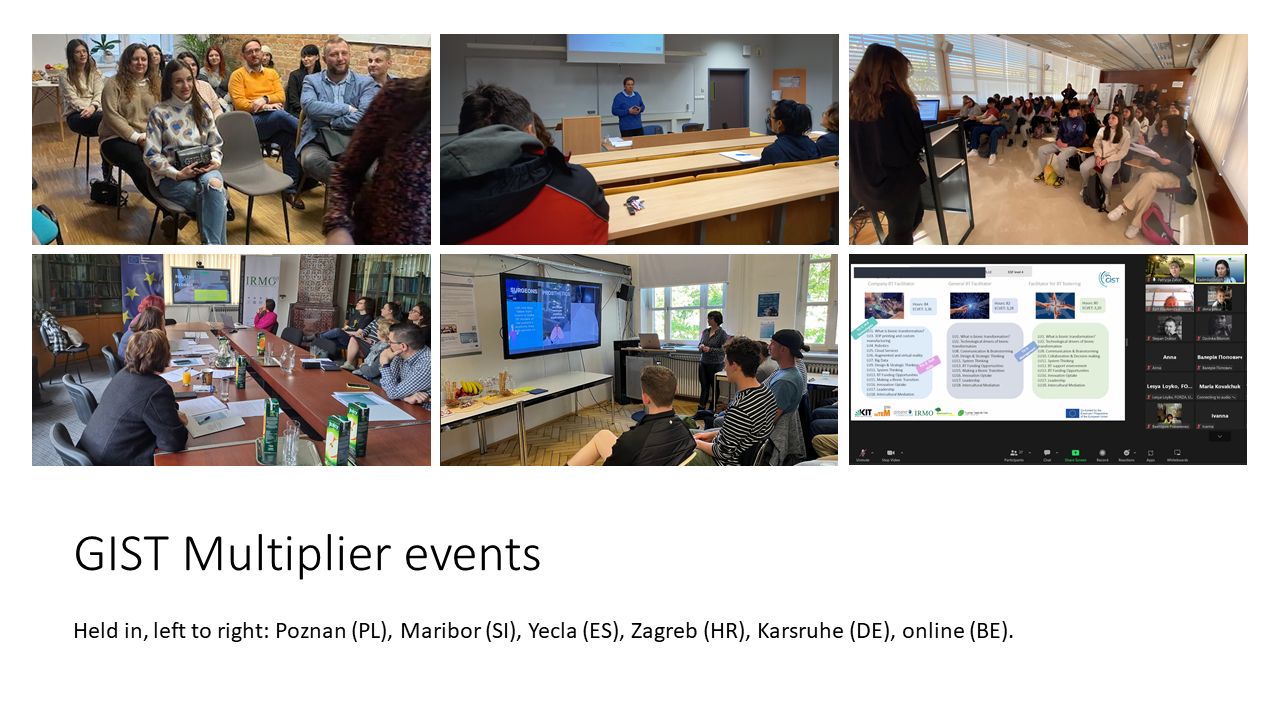
A Learning, Teaching, and Training activity was carried out in Maribor, Slovenia. Six multiplier events were organized, one in each partner’s country, with the purpose of introducing the project and its context, presenting the GIST project and its e-Learning platform, demonstrating developed materials and instructional examples, and evaluating the event and its content, while gathering feedback from participants. The satisfaction rate among participants in all events exceeded 90%.
Practical resusable results
Key study on current skills, knowledge, and qualifications regarding digitalisation
In this report, the specific objective of the Partnership was to conduct an in-depth investigation of the knowledge related to digital transformation. An analysis of the current situation was carried out through a survey and the findings of the analysis will be used for the preparation of a new educational programme that will enable the acquisition of new knowledge on digital transformation, Industry 4.0 for the bionic transformation of SMEs and will allow the strengthening of management capacity to introduce change.
GIST IO1_A1_Key Study on current skills, Knowledge, and qualification regarding digitalisation.pdf
Learning outcomes definition
Based on the results of the previous activity and the consultation of the “A European Handbook” of CEDEFOP, the needs and Learning Outcomes to be covered by the course were identified. This was followed by the harmonisation of the EQFs and NQFs of each country of the consortium in line with the needs and Learning Outcomes. EQF level 4 was identified for the development of the course.
GIST_IO1.A2 Learning Output Definition.pdf
Definition of training path and methodologies: JC Structure & A4. Joint Curriculum Validation
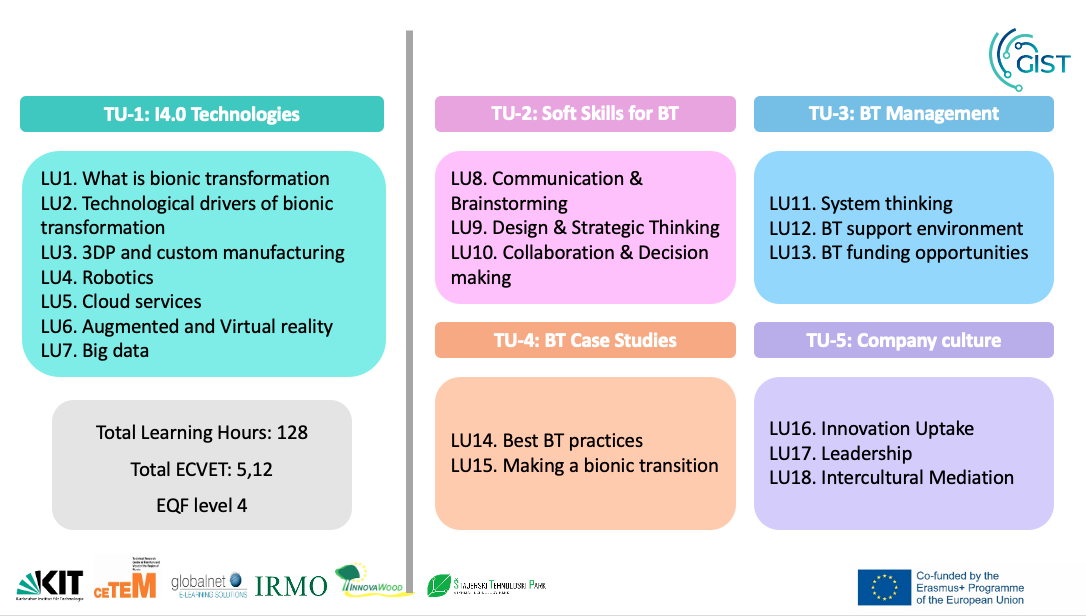
The course structure of the GIST project “Become a facilitator of bionic transformation” was defined and designed. Four training units were identified and the units that would compose each of them (18 in total) and learning paths for each of the identified target groups were identified. For each unit the learning outcomes, the duration, and the number of ECVET points that shaped the JC were identified. All this, together with the validation of the JC (A4) was collected in the A3 report “Definition of training path and methodologies”.
GIST_IO1.A3 Definition of training path and methodologies.v05(feb).pdf
Bionic Transformation Facilitator Training textbook
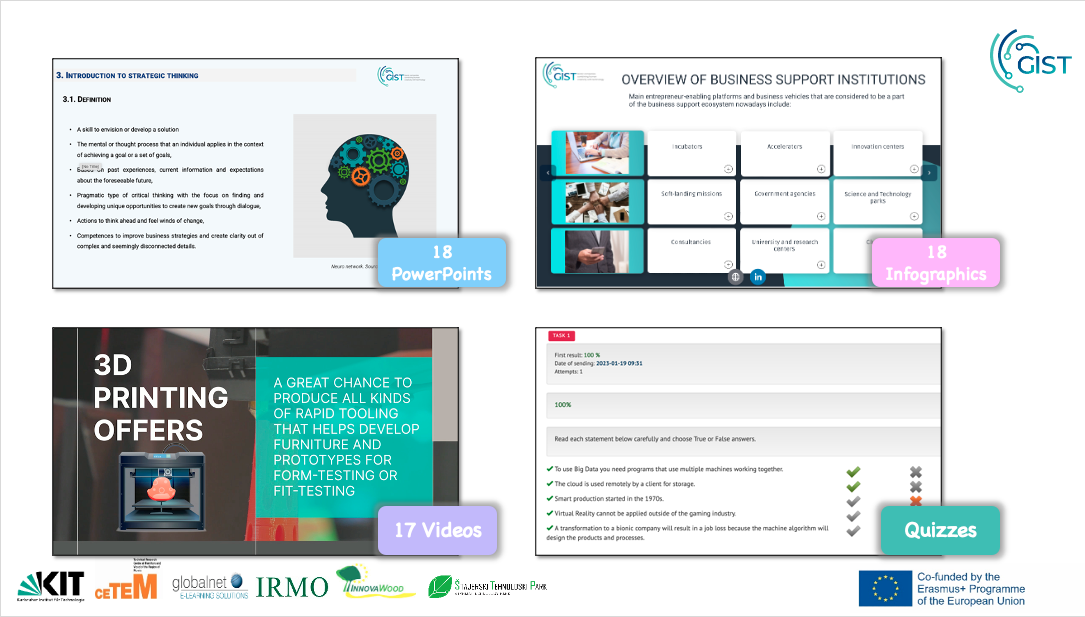
This document contains the PDFs of the 18 units (in English) developed for GIST project.
The GIST project focused on developing training content to enhance skills and knowledge about Bionic Transformation. This activity aimed to create effective and relevant materials to support the learning process and meet project objectives. These contents are also available in the 7 languages of the consortium on the e-learning platform.
Bionic_Transformation_Facilitator_EN_18_Units (1)
Learning platform Bionic Transformation Facilitator
An attractive, user-friendly, multilingual, and dynamic platform that also incorporates gamification. This e-learning platform contains all the educational content developed in the GIST project. Registration is required to access the content. Upon completion of the course, participants will be able to obtain a certificate that includes the number of hours, the user’s name, and the course name.
Link to the e-learning platform: https://www.losglobos.eu/form/gistTemp
YouTube GIST channel where all the project GIST videos are centralized and easily accessible.
Link: https://youtube.com/@gistproject


Project no:
2020-1-DE02-KA226-VET-008154
Duration:
June 2021 – May 2023
Website:
gist-project.eu
Coordinator
Dr.-Ing. Volker Koch
Karlsruher Institut für Technologie (KIT)
Building Lifecycle Management (BLM)
Englerstr. 7, 76131 Karlsruhe
Mail: volker.koch@kit.edu
www.kit.edu
Funding:
ERASMUS+ KA2
